
Autonomy isn't more permission, it's fewer questions to ask
🗄️ A team needs a new database.
⏱️ The work takes ten minutes.
🔒 The request waits for a security check.
📅 Then for the weekly change meeting.
✅ Two weeks later, it comes back approved.
Nobody did anything wrong. Without a better tool, a sign-off is the only way to stay in control.
However, this isn’t a necessary trade-off. When the platform checks every change against written rules and shows how well they are kept, oversight gets stricter and nobody waits. Teams that stay inside the rules never need to ask.
Checked on every change, not at every review

Rules checked on every change
Requirements like encryption, data location and key rotation are checked continuously, and every request passes the same checks an approver would make. Requests inside the rules go through on their own. Only exceptions go to a person.
Compliance you can measure
A live view shows how each team stands against your rules, mapped to NIS2, GDPR, ISO 27001 and E-ITS. You can see that delegation is working, not just hope it is.
Evidence before anyone asks
Every release, configuration change and access event is recorded with a time and a name, and nobody can edit it. Each team works in its own space, so a mistake stays contained.
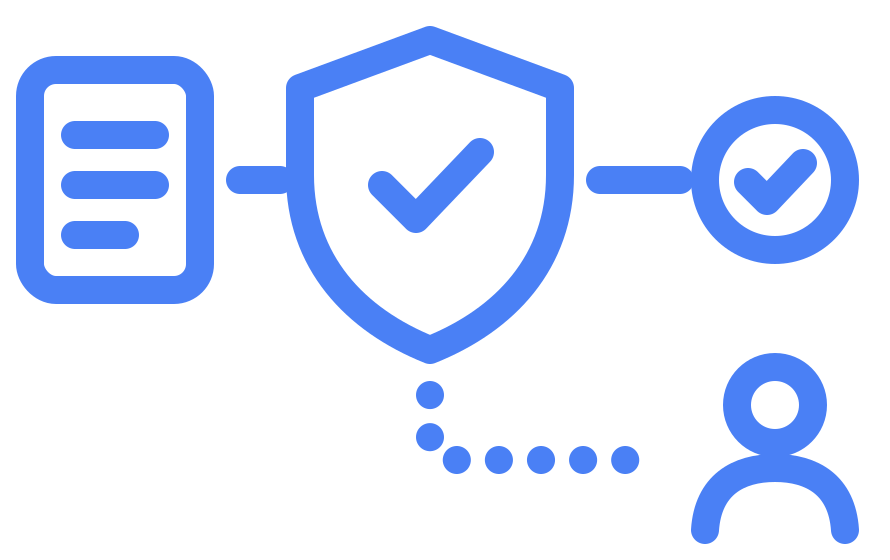
You decide the rules, we make them work
Engineering work
Turning an agreed rule into something the platform checks. Once it's in, it applies everywhere at once.
Examples:
- Data is stored only in regions you allow.
- Unencrypted storage is blocked before it's created.
- Expired keys are flagged until replaced.
Management work
Many policies exist on paper and are applied case by case. We can help lay out the options for deciding what they mean in practice.
Examples:
- Which data counts as personal, and where it may be stored.
- How often keys must change, and who can approve an exception.
- Which changes still need a person's judgement, and whose.
Start with reporting, enforce when you're ready
Your effort: 1 workshop with your security or compliance owner. Team leads handle their own findings.
1

Your security or compliance owner and our engineers write down the rules you already apply.
2

The platform checks current workloads against them and reports what's out of line.
3

Teams fix the findings.
4

The rules start blocking changes that break them.
The rules and the record stay yours
How you start
Rules apply at the platform level. Application code doesn't change and teams keep working as they do. The difference is which requests pass without a question.
How you leave
Your rules are stored as code and your audit history as data, in your own cloud accounts. Both stay readable without us.
Most sign-offs check for the same few things
When we map an organisation's approval steps, the same questions come up again and again: is the data encrypted, where is it stored, who has access. Those checks move into the platform. The decisions that need real judgement stay with people, and they get more attention because there are fewer of them.

Erki Arus
Platform implementation lead,
[PLACEHOLDER] Setting up a new environment used to take five sign-offs and two weeks. Now the rules are checked as the request goes in, and only the exceptions reach a person. Our security team sees more than before, and our teams wait less.
See which of your approvals could be a rule

Jürgen Käsper

Business Development
Focused on your goals, timeline, and commercial context. They'll map Entigo's value to your specific organisation and make sure the conversation moves at the right pace.

Rein Remmel
CEO
A technical expert who can go deep on architecture, compliance requirements, Kubernetes internals, CI/CD pipelines, and integration patterns: whatever matters most to your engineering team.
Bring one approval process to a 30-minute demo session. We'll show you which parts a platform could check and which still need a person.
What to expect:
- Bring one sign-off. Pick the approval your teams wait on most. We walk through it with you, step by step.
- Leave with a split. You'll see which checks the platform could run, which still need a person, and what it would take to move them.
If you'd like your security or compliance owner to join, feel free to forward the calendar invite.




info@entigo.com | (+372) 600 6130 | Veerenni 40a, Tallinn, 10138