
An invoice shows you the cost after it's already spent.
🧪 A team spins up a test environment for a two-week experiment.
✅ The experiment ends. The environment doesn't.
🧾 Three months later, finance asks about a line on the cloud bill.
🔍 Nobody can say whose it is.
Nobody did anything wrong. The team that could have switched it off never saw the cost.
The team making the architecture decisions is the only one that can change what the cloud costs, and usually they can't see the bill. Giving that team more freedom without that view is a risk, so most organisations compensate: every change needs approval, and cost becomes someone else's job.
See the cost of decisions as you make them

Cost on every team's screen
The team that knows what a resource is for assigns its cost centre, for a workspace, a shared zone or a single database. Each team then sees its spend, budget and forecast, with warnings while there's still time to act.
Waste, flagged as it appears
The platform points out unused resources, oversized machines, and places where a longer commitment would cost less.
Ready for your finance system
Cost data exports in a form your finance system can import, so cloud bills are split between cost centres without manual work.
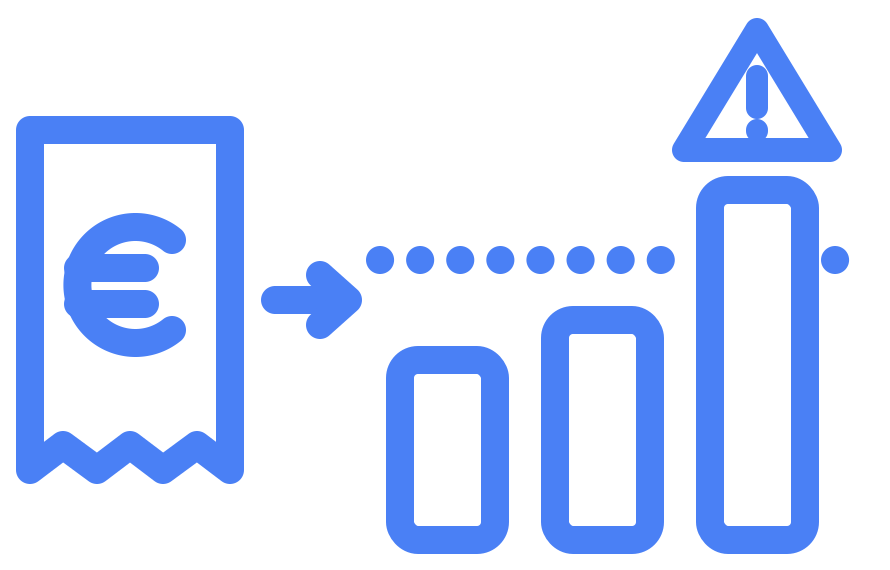
Cost ownership starts with the first team that moves over
Covered automatically
Everything created through the platform is labelled with its team and environment from the start, so costs land in the right place without extra effort.
Examples:
- A new database is billed to its workspace.
- A service added to a shared zone is billed to that zone.
- A new test environment shows on its team's budget from day one.
Needs a first pass
Resources created before the platform, or outside it, need labelling once. Shared costs, such as networking or common services, need a split your finance team agrees with. We can bring a proposed split, based on what has worked in similar organisations, so your finance team starts from a draft, not a blank page.
Examples:
- Resources created before the platform, or outside it.
- Shared networking and common services.
- Old test environments nobody has claimed.
Show each team its spend, then agree on the budgets
Your effort: one day to set up. Finance agrees the cost-centre map; team leads own their budgets.
1

Agree the cost-centre map with finance.
2

Turn on allocation and let each team see its own spend.
3

After 4 weeks, set budgets and warning thresholds per team space.
Your cost data stays in your accounts
How you start
The platform reads the billing data in your own cloud accounts. Nothing is resized or stopped without a decision from your team.
How you leave
Your bills stay with your cloud provider, and the labels stay on your resources. Your provider's own cost tools can keep reading them after you leave.
Budgets and cost-centre maps can be exported and set up elsewhere.
Teams fix what they can see
When teams first see their own spend, the easy savings often happen without a project: test environments get shut down, oversized instances get resized. Budgets and alerts matter for what comes after.

Erki Arus
Platform implementation lead,
[PLACEHOLDER] Our cloud bill used to arrive as one number nobody owned. Once each team saw its own spend, three forgotten test environments were switched off in the first week. Now cost comes up in design reviews, not budget meetings.
See your cost while you can still change it

Jürgen Käsper

Business Development
Focused on your goals, timeline, and commercial context. They'll map Entigo's value to your specific organisation and make sure the conversation moves at the right pace.

Rein Remmel
CEO
A technical expert who can go deep on architecture, compliance requirements, Kubernetes internals, CI/CD pipelines, and integration patterns: whatever matters most to your engineering team.
Bring one approval process to a 30-minute demo session. We'll show you which parts a platform could check and which still need a person.
What to expect:
- Bring one cloud bill. A recent month is enough. We go through it with you and match the biggest lines to the teams and services behind them.
- Leave with a map. You'll see which costs could be allocated to a team today, which are shared and need a split agreed with finance, and where the first savings are likely.
- If you'd like someone from finance to join, feel free to forward the calendar invite.






info@entigo.com | (+372) 600 6130 | Veerenni 40a, Tallinn, 10138